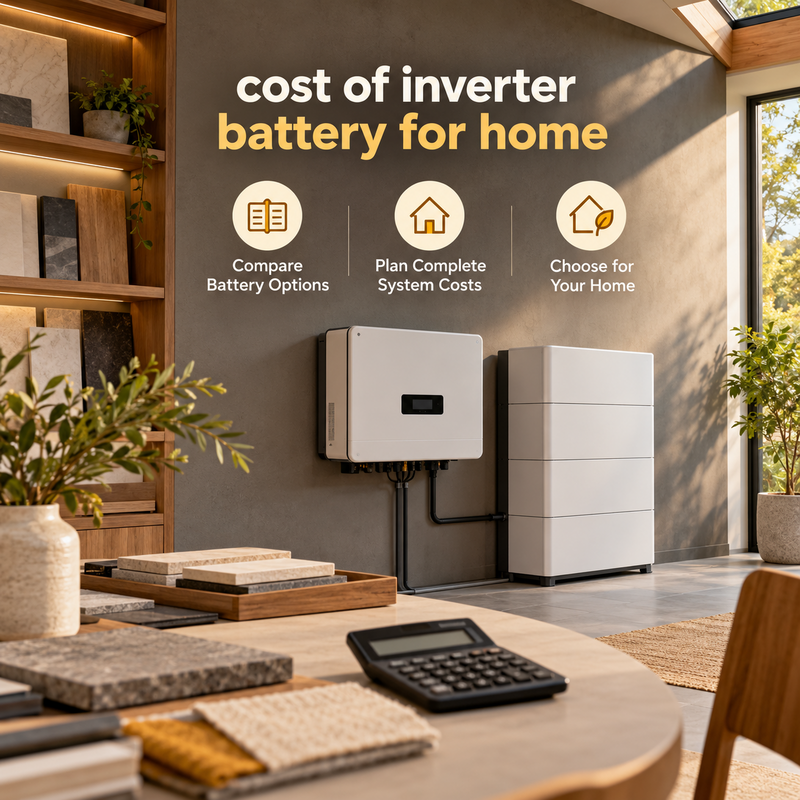
Cost of Inverter Batteries for Home Use

5,000+ units ready stock, 1–5 days fast global delivery

application/cost-of-inverter-battery-for-home, application/cost-of-inverter-battery-for-home, 
Inquiry
Inquiry

cost of inverter battery for home

Understanding the  cost of  inverter batteries for home  use  is essential for purchasing managers and  engineers who are considering energy storage solutions.  As the demand  for  reliable energy sources grows,  so does  the  need to evaluate costs effectively. This article  will address key factors influencing inverter  battery pricing, helping  buyers make  informed decisions  while  navigating  their  options in  the market.

Where to Find Reliable Suppliers for Inverter Batteries in Bulk

Where to Find Reliable Suppliers for Inverter Batteries in Bulk

Finding reliable suppliers for inverter batteries in bulk  requires careful research and evaluation. Start by looking for  manufacturers with a proven  track record in the industry, such as Shenzhen Yanshuosheng Technology Co., Ltd., known  for its LiFePO4 energy storage systems. Suppliers with extensive  export experience, particularly those serving multiple  countries, are often  more reliable due to  their established quality control  processes and understanding of international standards.


Industry trade shows  and online marketplaces can also be  valuable resources for  identifying potential suppliers. Engaging with professionals in  online forums or industry-specific  networks can provide insights into supplier reputation and reliability. It’s crucial to request samples before committing to bulk orders, ensuring that  the products  meet your quality and performance expectations.


Lastly, consider suppliers that  offer customization options, as this can help tailor  products to specific applications or requirements, enhancing overall value and satisfaction.

How to Evaluate the Quality of Inverter Batteries for Home Use

Evaluating the quality of  inverter batteries involves several key assessments. Start by examining the manufacturer's certifications and compliance with  industry standards, such as UN38.3 and CE. These certifications indicate that the batteries have undergone rigorous testing for safety and performance.

Next,  analyze the  battery's specifications, including cycle life, discharge rates, and  thermal performance.  A battery with a higher cycle life is more desirable,  as it indicates longevity and less frequent  replacement. Understanding the  discharge  rates is also  vital; a battery  that can discharge at a higher rate  may be necessary for applications requiring substantial power in short bursts.

Conducting a  thorough  inspection of the physical battery is equally important.  Look for signs of quality in materials used, such as corrosion resistance and robust casing. Requesting detailed product data sheets can also aid in comparing specifications  among different  suppliers.

Lastly, consider the warranty offered by  the manufacturer. A longer  warranty period typically reflects confidence in product quality and performance, providing peace of mind for buyers.

Common Problems with Inverter Batteries and Their Solutions

Inverter batteries can experience several common  issues that may  impact  their performance and  lifespan. One frequent problem is  battery swelling or  overheating, often caused by overcharging or high temperatures. To  address this, ensure that the  installed battery management system (BMS) is functioning correctly and that  the charging  equipment is compatible and  correctly configured to prevent overcharging.

Another issue is reduced capacity over time, which can be exacerbated by deep  discharging  practices.  Buyers should educate users on best practices for discharging and charging cycles to extend battery life.  Regular maintenance checks,  including monitoring voltage levels and inspecting connections, can help identify potential issues before they escalate.

Lastly, improper installation can lead  to connectivity problems and decreased efficiency. Ensure that installation guidelines are followed precisely, and consider hiring  professional installers familiar with inverter battery  systems to mitigate installation-related  risks.

Installation Guidance for Inverter Batteries in Residential Settings

Proper installation of inverter batteries is crucial for optimal performance and safety. Begin by selecting an appropriate  location for installation—ideally, a dry, ventilated area away  from direct  sunlight and  extreme  temperatures. This will help maintain the battery's performance and longevity.

Before  installation, ensure that the electrical system in the home is compatible with the battery specifications. Reviewing the inverter's rating and  ensuring it aligns with the battery's capacity is essential. Any discrepancies can lead to system inefficiencies or failures.

During installation, follow the manufacturer’s guidelines closely.  This includes proper  wiring techniques and ensuring secure  connections to prevent  arcing  or short  circuits. Additionally, it may be beneficial to install the battery within a rack or enclosure that provides additional protection against environmental  factors.

Once installed, conduct thorough testing to confirm that the system operates correctly. Monitoring the  system regularly  will help identify any issues early on, ensuring the energy storage solution continues to meet household  energy needs efficiently.

understanding the cost of inverter batteries for home use involves careful consideration of various factors, including technology, capacity, quality, and supplier  reliability. By following the guidance provided , purchasing managers and  engineers can make informed decisions that enhance their energy  storage solutions.

What to Consider When Comparing Inverter Battery Costs for Homes

When comparing the  cost of inverter batteries for home use, several  critical factors come  into play. First, assess the battery technology. Lithium  Iron Phosphate (LiFePO4) batteries typically offer longer life cycles and  greater efficiency compared to traditional lead-acid batteries, but they come with a higher upfront cost. This advanced technology provides benefits such as safety, thermal stability,  and a higher depth of  discharge, which can  lead to cost savings over time through reduced replacement frequency.

Next, consider the capacity and power output requirements. The cost  can vary  significantly  based on the battery's amp-hour (Ah) rating and its voltage. For instance, a higher capacity battery will  cost more but may  be crucial for homes with greater energy demands or  those looking to power multiple devices during outages.

Additionally,  factor in the Battery Management System (BMS). A well-designed BMS enhances battery performance and safety, adding to the overall cost but ensuring longevity and  reliability. Certifications such as UN38.3 and CE are also  vital indicators  of quality and safety standards, which  can  justify higher prices.

Get a Free Quote

Our representative will contact you soon.
0/1000