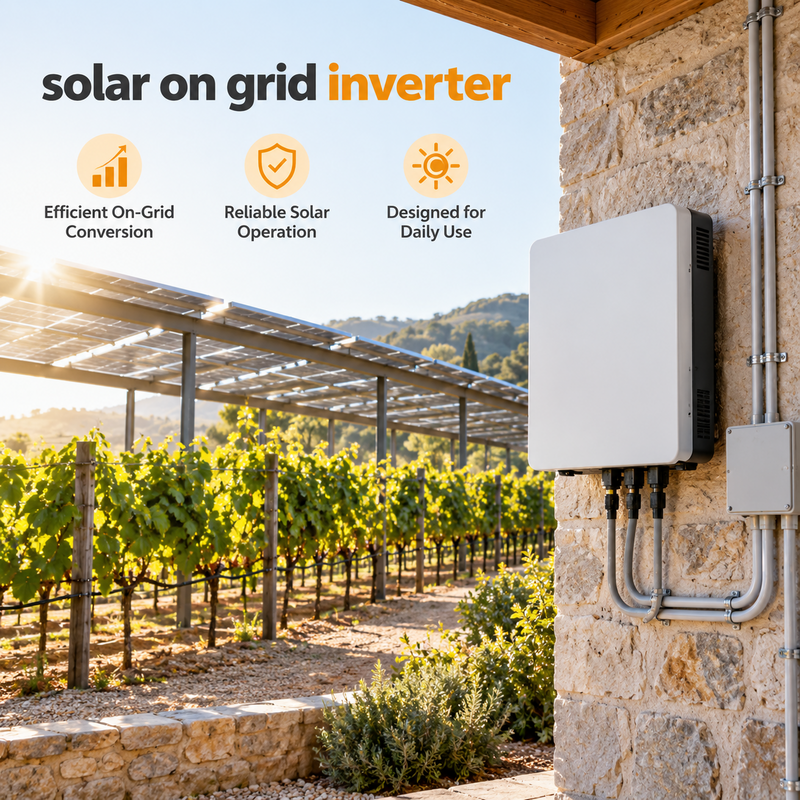
Key Features of Solar On-Grid Inverters

5,000+ units ready stock, 1–5 days fast global delivery

application/solar-on-grid-inverter, application/solar-on-grid-inverter, 
Inquiry
Inquiry

solar on grid inverter

Solar on-grid  inverters play a crucial role  in modern  renewable energy systems,  enabling the efficient  conversion of solar  energy into usable electricity for homes and  businesses. As  purchasing managers and engineers evaluate these systems, key  considerations include  performance specifications,  compatibility with existing infrastructure, and overall reliability. This article will provide a comprehensive  guide to  solar on-grid  inverters,  covering their key  features, partnership opportunities, essential knowledge, common challenges,  and  industry  applications to help inform your purchasing decisions.

 
Partnering for Solar On-Grid Inverter Success

Partnering for Solar On-Grid Inverter Success

Choosing the right supplier is critical for the success  of your solar project. When evaluating potential partners,  consider the following:

Experience and Expertise: Look for manufacturers like Shenzhen Yanshuosheng Technology Co., Ltd., which specialize in energy  storage  systems and have a proven track record in the solar industry. Their  expertise can provide insights into product  selection and system optimization.


Customization Options: Some projects may require specific inverter configurations or features. Discuss customization capabilities  with your  supplier to ensure that the final product  meets your  unique requirements.

Support and  Service:  Evaluate the level of technical support  and after-sales service offered by the  manufacturer. A responsive  support team can help address any  issues that arise during installation and operation.

Production Capacity: Verify the manufacturer’s production capabilities to ensure they can meet your project timelines  and order  quantities. Understanding their minimum order quantities (MOQ) can also help you  plan your purchasing strategy.

What You Need to Know

Before  making a purchasing decision regarding solar on-grid inverters, there are several  key  aspects to consider:

Installation Requirements:  Understand  the installation process, including any necessary electrical work and compliance with local regulations. Ensure your installation team is equipped to handle the technical aspects of integrating the inverter with your solar array.

Warranty and Maintenance: Inquire about the warranty period and what it covers. A robust warranty can provide peace of mind regarding the longevity and reliability of  your  investment. Additionally, discuss routine maintenance requirements to  ensure optimal performance.


Compatibility with Energy  Storage Systems:  If  your project involves energy storage, ensure that the inverter is compatible with your LiFePO4 energy storage systems. This can enhance the  efficiency of your  solar setup by allowing for energy storage  during peak production  times.

Cost Considerations: Understand the factors that influence pricing, including  inverter specifications, features, and market demand. Comparing multiple suppliers can help you identify  the best  value for your project.


Common Problems with Solar On-Grid Inverters and Effective Solutions

While solar on-grid inverters are generally reliable, several common issues can arise. Being aware of  these can help you  mitigate risks:

Overheating:  Inverters can experience  overheating  if not properly ventilated. Ensure that your  installation allows for adequate airflow and consider  models with built-in thermal management systems.

Grid Connection Issues:  Problems with the grid connection can lead to system failures. Ensure that your  inverter  is compatible with your local grid standards  and regulations to avoid connectivity issues.


Software Glitches: As many inverters now  feature software for monitoring and performance optimization,  software bugs  can occasionally disrupt functionality. Regular updates  and monitoring can help mitigate these issues.

Underperformance: If the  inverter is  not performing as expected, check for compatibility issues with the solar panels or other system components. Regular performance  assessments can help identify and rectify underperformance early.


Applications of Solar On-Grid Inverters in Various Industries and Projects

Solar  on-grid inverters are versatile and can be utilized across multiple sectors. Here are some common applications:

Residential: In residential  applications, solar on-grid inverters enable homeowners to utilize solar energy to power their homes, reducing  reliance on grid electricity  and lowering utility bills.

Commercial: Businesses can significantly benefit from solar installations. On-grid inverters help in maximizing  energy savings and  improving sustainability profiles,  which can be  a competitive advantage in many industries.

Industrial: Large-scale industrial  operations often employ solar on-grid systems to offset  considerable  energy consumption. The efficiency of these inverters is crucial for maintaining operational costs.

Marine and RV Applications: For marine and recreational vehicle (RV)  applications, specialized  solar on-grid inverters can provide reliable power for onboard systems, enhancing comfort  and convenience while  reducing the need  for fuel-based generators.


By understanding the key features and considerations associated with solar on-grid inverters, you  can  make informed decisions that align with your energy needs and project goals. Partnering with a  reputable manufacturer like Shenzhen Yanshuosheng Technology Co., Ltd. ensures access to high-quality products and expertise that can support your solar energy initiatives effectively.

Key Features of Solar On-Grid Inverters

Solar on-grid  inverters are designed to convert  direct current (DC) electricity generated by solar panels into alternating current (AC)  electricity, which is suitable  for use in homes and businesses. Key features to consider  include:

Efficiency: The conversion efficiency of  an inverter is critical. Look  for models that offer efficiencies above 95%, as this directly impacts the amount of solar energy that  can be utilized.

Power Output: Inverters  are rated by their maximum power output, typically measured in kilowatts (kW). Ensure the inverter’s  capacity aligns with  the total output of your solar array to avoid underutilization.

Communication  Capabilities: Many modern inverters come equipped  with monitoring systems  that allow for real-time performance tracking. This feature can be invaluable for troubleshooting and optimizing system performance.

Durability  and Design: Consider inverters that  are built to withstand environmental conditions typical to your project location. Look for models with weather-resistant enclosures and robust thermal management  systems.

Certification: Ensure that the inverter complies  with relevant safety and performance standards, such  as UN38.3 and CE certifications. This guarantees that the product meets essential  safety and operational requirements.

Get a Free Quote

Our representative will contact you soon.
0/1000