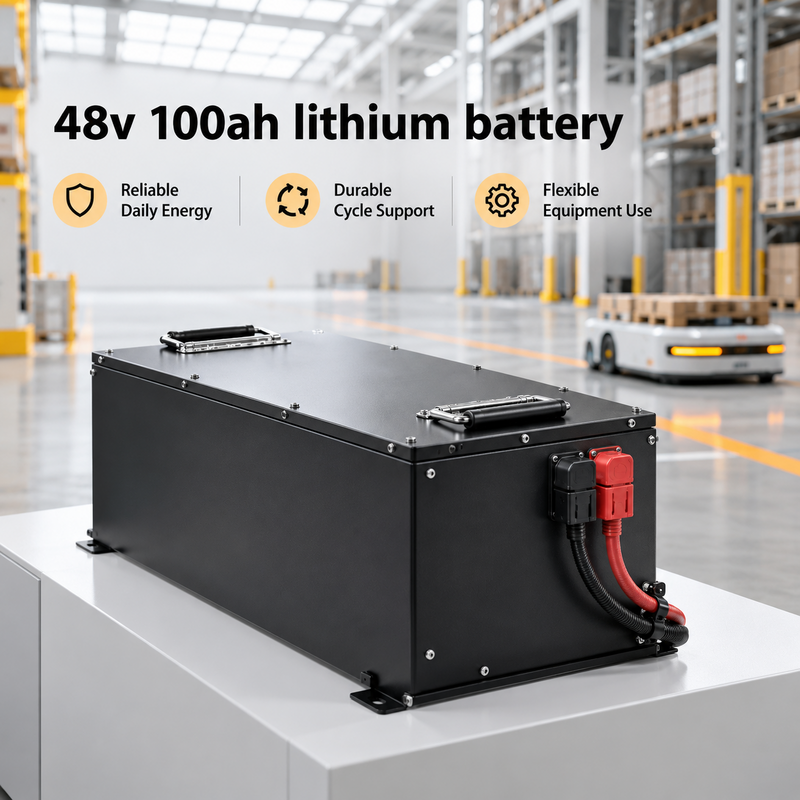
Choosing the Right 48V 100Ah Lithium Battery

5,000+ units ready stock, 1–5 days fast global delivery

application/48v-100ah-lithium-battery, application/48v-100ah-lithium-battery, 
Inquiry
Inquiry

48v 100ah lithium battery

48V 100Ah lithium batteries are increasingly popular in various applications due  to their efficiency, longevity,  and reliability.  As a purchasing manager or product manager,  you might have several  concerns when  considering these energy storage solutions,  such  as performance, quality, compatibility with existing systems,  and supplier  reliability.  This article will  provide you  with essential insights  into selecting the right 48V  100Ah lithium  battery for your projects, key specifications to consider,  quality evaluation for bulk  orders,  reliable  sourcing options, and common problems along with their solutions.

Key Specifications of 48V 100Ah Lithium Batteries Explained

Key Specifications of 48V 100Ah Lithium Batteries Explained

Understanding key specifications can help  you make  informed decisions. Here  are important aspects to consider:

Capacity: Measured in  ampere-hours (Ah), the 100Ah rating indicates how much energy the battery can store. Higher  capacity batteries can supply power  for longer periods, which  is critical for applications requiring extended use.

Voltage:  The  nominal voltage of 48V is standard for  many commercial applications, but ensure that  your equipment is compatible with this voltage to prevent operational issues.


Cycle Life: Refers to the number of complete  charge and discharge cycles a battery can undergo before its capacity significantly diminishes. A longer cycle life indicates better longevity and value.

Depth  of Discharge (DoD): This percentage indicates how much of the battery's capacity can be  used without damaging it. For instance, a DoD of 80% means you can safely use  80% of the battery's capacity.

Charge and Discharge Rates: These rates  are usually measured in C-rate,  indicating how quickly the battery can be charged or discharged. Higher rates  can be beneficial for applications requiring rapid energy delivery  or replenishment.

Evaluating these specifications against your project requirements will help ensure you choose a battery that meets your needs effectively.

Evaluating the Quality of 48V 100Ah Lithium Batteries for Bulk Orders

When purchasing 48V 100Ah lithium  batteries  in bulk, quality  evaluation is vital to avoid costly mistakes. Start with supplier certifications  such as UN38.3 and CE, which indicate compliance with international safety standards. These certifications ensure that the  batteries have been  tested for safety and performance.

Next, examine  the  manufacturing processes used by the supplier. A reliable  manufacturer should have a  comprehensive quality control  system, including regular testing of battery cells and  packs during production.  Ask  for documented testing methods  and results to assess  consistency.

Request samples before placing a bulk order. Testing these  samples under real-world conditions can reveal performance issues that might not be apparent from specifications alone. Additionally, confirm the manufacturer's ability to  provide ongoing support and service, as this  can be crucial  for maintenance and troubleshooting.

Where to Find Reliable Suppliers of 48V 100Ah Lithium Batteries

Finding reliable suppliers is  key to securing high-quality 48V  100Ah lithium batteries.  Start by researching manufacturers known for  their expertise  in  lithium battery technology, such as Shenzhen Yanshuosheng Technology Co., Ltd., which specializes in  High Performance 50Ah LiFePO4 Lithium Ion Battery Pack energy storage  systems.

Industry  trade shows and exhibitions can also be fruitful venues for finding suppliers. They  provide opportunities to meet  manufacturers, see products  firsthand,  and discuss  specific needs. Online platforms  like industry directories and  B2B marketplaces can also help  you identify potential suppliers, but ensure to verify their credentials and customer reviews.

Networking within  industry forums and groups can yield personal recommendations and insights into suppliers’ reputations. Always perform due diligence by requesting references and assessing the supplier's track record in  terms of product quality and customer  service.

Common Problems and Solutions with 48V 100Ah Lithium Batteries

Understanding  common issues associated with 48V 100Ah lithium batteries can help you mitigate risks.

Overcharging: This can lead to reduced battery life or even failure. Ensure your BMS has protective features to prevent overcharging and monitor charging cycles closely.

Temperature Sensitivity: Lithium batteries can be sensitive to temperature  extremes. Implement thermal  management  solutions or choose  batteries designed for specific temperature ranges to prevent performance degradation.


BMS Failures: A faulty BMS can lead to inefficient performance or safety  hazards. Regularly inspect the BMS for  proper  operation and consider purchasing batteries with independent BMS systems for added reliability.

Decreased Capacity Over  Time: All batteries lose capacity over cycles, but having a rigorous maintenance schedule can help prolong their life.  Regularly assess battery health and replace aging units as  necessary.


By proactively  addressing these common issues, you  can enhance the reliability and performance  of your 48V  100Ah lithium battery systems.

In summary, understanding your application needs, evaluating key specifications, ensuring supplier reliability, and anticipating common problems will  guide you  in making  informed decisions regarding 48V 100Ah lithium batteries for your projects.

Choosing the Right 48V 100Ah Lithium Battery for Your Projects

Selecting the appropriate 48V 100Ah lithium battery is crucial for optimizing  performance  in applications such as solar energy storage, RVs, UPS systems, and marine usage. Start  by considering the application requirements. For solar systems,  ensure the battery  can handle  frequent charge and discharge cycles. For  RVs, size and weight  are critical, as they impact vehicle performance. Additionally, a reliable option to consider for solar applications is the Energy Storage Systems 3.6KW 5.5KW 24V 48V On/Off Grid Solar Inverter.


Evaluate the battery's  depth of discharge (DoD)  and  cycle life;  a  higher DoD means you  can utilize more of the battery's capacity without damaging it, while a longer cycle  life translates to  lower replacement costs over time. Additionally, consider the battery's temperature  tolerance, particularly if it will  be installed in environments with extreme temperatures.

Lastly, compatibility with your existing systems is vital. Ensure the battery's voltage  and capacity align with your energy needs and that it can interface with your existing battery management system (BMS).

Get a Free Quote

Our representative will contact you soon.
0/1000