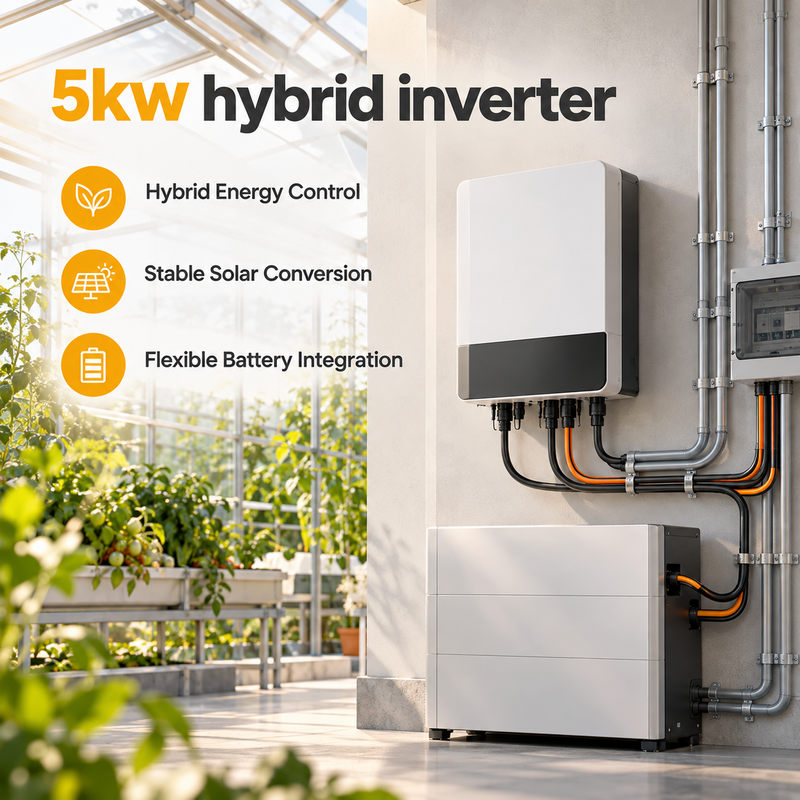
5kW Hybrid Inverter: Key Considerations for Buyers

5,000+ units ready stock, 1–5 days fast global delivery

application/5kw-hybrid-inverter, application/5kw-hybrid-inverter, 
Inquiry
Inquiry

5kw hybrid inverter

Choosing the right  5kW  hybrid inverter is  crucial for various applications, including residential  energy storage, solar power systems, and industrial setups. This  article  will  explore  key considerations for  purchasing a 5kW  hybrid  inverter, focusing on specifications, quality evaluation, and common applications. As a B2B  buyer, understanding  these  aspects will  help you make  informed  decisions, ensuring that  the inverter meets your  project's requirements  and operational efficiency.

Key Specifications of 5kW Hybrid Inverters for Wholesale Buyers

Key Specifications of 5kW Hybrid Inverters for Wholesale Buyers

For wholesale  buyers, understanding the critical specifications  of 5kW hybrid inverters is essential:

Output  Power: The inverter's rated output power must match or exceed the total load of the connected devices. A 5kW inverter is  suitable for small to medium residential applications but may not suffice for larger industrial applications.

Input Voltage Range: This specification indicates  the range of input voltages the inverter can handle. Ensure that  it aligns  with your energy generation system to avoid performance issues.

Efficiency: Look for inverters with a maximum  efficiency rating  (often  provided in the specifications) and a European Efficiency (EU) rating to gauge performance  during varying operating conditions.


Surge Capacity: This specification refers to the inverter's ability to handle short bursts of high power, such as when starting motors. Ensure  that the  inverter can accommodate the surge requirements of devices you plan  to connect.


Dimensions and Weight:  Consider the physical size and weight of the inverter, especially for installations  with space constraints. Compact designs can ease installation and maintenance.

Cooling  Mechanism: The inverter may employ passive or active cooling methods. Active cooling (like fans) can be beneficial for maintaining performance in hot environments, while passive cooling can be  more reliable over time.

How to Evaluate the Quality of 5kW Hybrid Inverters for Procuremen

Evaluating the  quality of a 5kW  hybrid  inverter  involves several considerations:

Manufacturer Reputation: Research the manufacturer's history, customer  reviews, and industry reputation. Established companies often have rigorous quality  control processes and a track record of reliability.

Certification and Testing: Verify that the inverter has undergone appropriate testing and holds necessary certifications. This ensures  adherence  to safety and performance standards, reducing the risk of  operational  failures.

Warranty and Support: A robust warranty policy  indicates the manufacturer’s confidence  in their product. Assess the warranty period and what it  covers, including parts and labor, to ensure adequate protection.


Quality Control Processes: Inquire about the  manufacturer’s quality control measures during production. Regular testing and inspections can significantly reduce defects and enhance product reliability.

Field Performance: Seek feedback  from existing customers about real-world  performance. Understanding  how  the inverter operates under different conditions can  provide valuable insights into its reliability and efficiency.

Applications of 5kW Hybrid Inverters in Various Industries

5kW hybrid  inverters have  versatile applications across multiple industries:

Residential Energy Storage: Homeowners use these inverters to manage energy  from solar  panels and battery systems,  allowing for efficient energy use and backup power during  outages.

Commercial  Solar Systems: Small businesses often integrate 5kW inverters with solar arrays to reduce energy costs  and  achieve  sustainability goals.

Recreational Vehicles (RVs):  RV owners utilize these  inverters to power  appliances and electronics  while on the road, providing  a reliable source of off-grid power.

Marine Applications: In marine settings,  5kW hybrid inverters  are essential for operating onboard systems, ensuring safety and comfort.

Uninterruptible Power  Supplies (UPS): These inverters are critical  in UPS systems, providing backup power to sensitive equipment during electrical  outages.

Common Problems with 5kW Hybrid Inverters and Effective Solutions

Despite their advantages, 5kW hybrid inverters can encounter issues.  Here are common problems and solutions:


Overheating: Inverters can overheat in high ambient temperatures or if  ventilation is inadequate. Ensure proper installation with adequate airflow and consider active cooling solutions for prolonged operation.

Incompatibility  with Batteries: Using batteries that  do not match the inverter's specifications can  lead to performance  issues.  Always verify compatibility with the chosen battery technology.


Faulty Installation: Poor installation can lead to inefficiencies or failures. Engage qualified professionals for installation and regularly  inspect connections to ensure reliability.

Software Glitches: Inverters  with advanced monitoring features  may experience software-related issues. Regular firmware updates from the manufacturer can resolve these glitches and enhance functionality.

Inverter Failure: If an inverter fails, check for blown fuses or  circuit breakers.  If problems persist,  consult the manufacturer for troubleshooting or warranty  service.

By understanding these specifications, applications,  and potential issues, B2B buyers  can make informed decisions when sourcing 5kW hybrid inverters, ensuring they meet  the demands of their projects  effectively.

What to Consider When Choosing a 5kW Hybrid Inverter for Your Projects

When selecting a 5kW hybrid inverter, several  factors should be taken into account:

Compatibility with Energy  Sources: Ensure the inverter can  effectively integrate with your existing energy sources, whether solar panels, wind turbines,  or grid connections. The  inverter must support  the input voltage and power output of your energy generation system.


Battery Compatibility: Check the inverter's specifications for compatibility with various battery types, particularly LiFePO4  batteries, which are known for  their stability and long cycle life. A suitable inverter should  be capable of handling the charge and discharge rates of the batteries used.

Efficiency Ratings: Look for inverters with high efficiency ratings, typically above 90%. Higher efficiency means less  energy loss during conversion, which is vital for  maximizing energy savings.

Control and Monitoring Features: Advanced inverters come equipped with smart monitoring capabilities that allow real-time performance tracking, remote management, and troubleshooting. This feature is crucial for ensuring optimal operation and  maintenance.

Regulatory Compliance: Ensure the inverter  meets relevant certifications and standards, such as UN38.3  and CE, to  guarantee safety and reliability. Compliance with local regulations is essential  for installation and operation.

Customization Options: Depending  on your project's  specific requirements,  you may need to discuss customization options with the manufacturer. This could involve programming specific settings or integrating additional features.

Get a Free Quote

Our representative will contact you soon.
0/1000