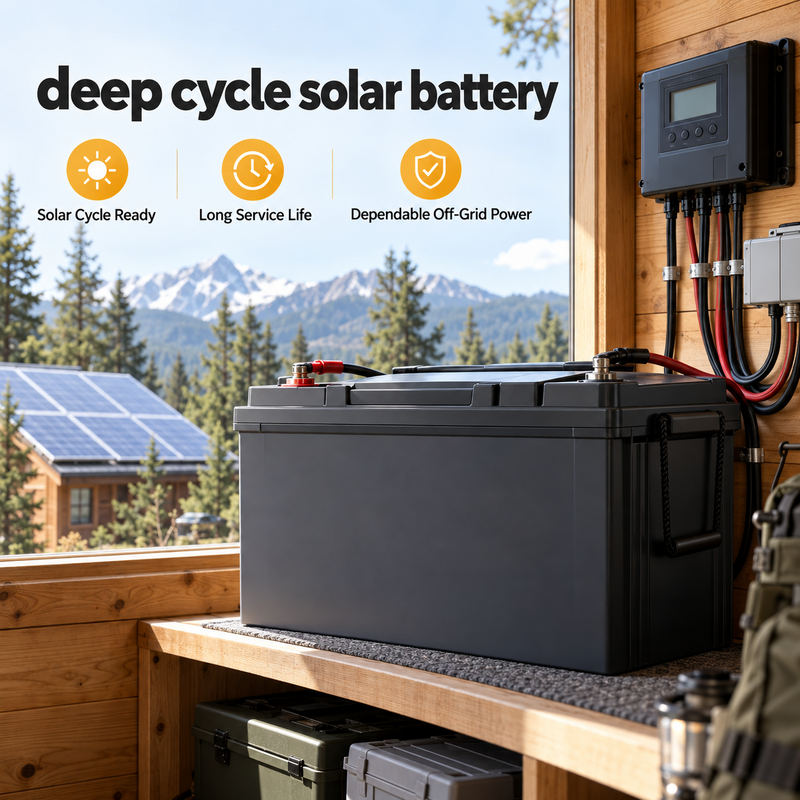
Key Specifications for Deep Cycle Solar Batteries

5,000+ units ready stock, 1–5 days fast global delivery

application/deep-cycle-solar-battery, application/deep-cycle-solar-battery, 
Inquiry
Inquiry

deep cycle solar battery

Deep cycle solar batteries are essential components  in  renewable energy  systems,  particularly for solar energy storage. They are  designed to discharge  and recharge repeatedly, making  them  ideal for applications that  require  consistent energy supply over an  extended period. For buyers in commercial and industrial settings, understanding the specifications, installation, and common issues  related to deep cycle solar batteries  is crucial for making informed purchasing  decisions. This article will provide insights  into  key specifications,  comparison methods, installation guidance, common  problems, and the various applications of deep cycle  solar batteries.

 
How to Compare Deep Cycle Solar Batteries for Your Projects

How to Compare Deep Cycle Solar Batteries for Your Projects

When comparing deep cycle  solar  batteries, buyers should consider several factors to ensure they  select the right product for their specific applications:

Performance Metrics: Assess the manufacturer's performance  data, including efficiency  ratings and temperature tolerance. High-performance batteries often maintain efficiency across a range of environmental conditions.

Manufacturer Reputation: Evaluate suppliers based on their industry experience and customer feedback. A manufacturer with a strong reputation is more likely to provide reliable products  and support.

Warranty and Support: Investigate the warranty  terms offered. A longer  warranty often indicates  the manufacturer’s confidence  in their product. Additionally, consider the quality of customer service  and technical support available post-purchase.

Price vs.  Value: While cost is an important factor, it should not be the  sole consideration. Assess the  overall value, including performance, longevity, and efficiency, to ensure the battery meets both budget  and functional requirements.

Customization Options: Some projects  may require specific battery  configurations or capacities. Check if the manufacturer can support  custom orders to meet unique project demands.

By systematically comparing these  factors, buyers can make informed choices  that align with their project requirements.

Installation Guidance for Deep Cycle Solar Batteries in Various Applications

Proper installation of deep  cycle solar batteries is vital for optimal performance and longevity. Here are some guidelines for various applications:

Solar  Energy Systems: Ensure batteries  are installed in  a  well-ventilated area  to dissipate  heat generated during charging. Use appropriate mounts and protective enclosures to safeguard against environmental factors.

RV and  Marine Applications: When  installing batteries in RVs or boats, secure them to prevent movement during transit. Consider using battery boxes to protect against moisture and physical damage.

UPS Systems: For uninterruptible power supply (UPS) systems, ensure a seamless integration with the inverter and load management systems. Regularly check  connections for corrosion and  ensure proper  grounding.


Residential Storage: In residential systems, connect batteries in accordance with the manufacturer's wiring  diagrams.  Use fuses or circuit breakers  to protect against overloads, and consider integrating battery management  systems (BMS) for  monitoring health and performance.

Each installation scenario may have unique requirements; therefore, always refer to the manufacturer's installation guidelines and  best practices.


Common Problems with Deep Cycle Solar Batteries and Their Solutions

Despite their durability, deep cycle solar batteries can encounter several common issues.  Here are some problems and  their solutions:

Sulfation: This occurs when the battery is undercharged, leading  to  the formation of lead sulfate crystals. To prevent sulfation, ensure regular charging and maintenance, and use a  battery charger with a desulfation function  if  necessary.

Overheating: Excess heat can  damage battery cells and reduce lifespan. Ensure proper ventilation and  avoid overcharging. Monitor battery temperatures during operation  to  detect  potential issues early.

Shortened Cycle  Life: Frequent deep discharges can significantly shorten a battery's life. To mitigate this, adhere to recommended DoD limits  and incorporate a battery management system to optimize charging and discharging cycles.

Corrosion: Battery  terminals can corrode over time, leading to poor connections. Regularly clean terminals and  apply a protective coating to  prevent moisture  buildup.

By being aware of these issues, buyers can take proactive measures to ensure  battery  longevity and reliability.

Understanding the Applications of Deep Cycle Solar Batteries in Industry

Deep cycle  solar batteries are versatile and find applications across various industries. Here are some key sectors utilizing these batteries:

Renewable Energy: In solar energy systems, deep  cycle batteries store excess energy generated  during the  day for nighttime use, ensuring a continuous power supply.

Recreational Vehicles (RVs): RV owners rely on deep cycle  batteries for powering appliances,  lights,  and other electronics while on the road or  camping. Their ability to withstand repeated  charging  and discharging cycles  is crucial in this application.

Marine: In  marine settings, deep  cycle batteries power navigation systems, lights, and other onboard electronics, providing reliability for extended  voyages.

Uninterruptible Power Supplies (UPS): Businesses and data centers use deep cycle batteries  in UPS systems to provide backup power during  outages, protecting sensitive equipment from damage.

Telecommunications: Remote communication towers utilize deep cycle  batteries  for backup power, ensuring continuous operation in case of grid failures.

Understanding these applications helps buyers recognize the versatility and importance  of deep cycle solar  batteries in meeting diverse energy storage needs across industries.

Key Specifications for Deep Cycle Solar Batteries in Bulk Orders

When considering deep cycle solar batteries for bulk orders, it's important to evaluate several  key specifications:


Capacity: Measured in amp-hours (Ah), this indicates how much charge the battery can store. The right  capacity depends on your  energy  needs and the duration for which you wish to use the battery.  Higher capacity batteries can provide longer usage times but may come at a  higher cost.

Voltage: Common configurations include 12V, 24V, and 48V. The voltage should match your  solar power system to ensure compatibility. A mismatch can lead to inefficiencies  or system failures.


Cycle Life: This refers to the number of  discharge  and recharge cycles a battery can endure before its capacity significantly diminishes. Look for batteries with a high cycle  life to reduce replacement frequency and overall costs.

Depth  of Discharge (DoD): This indicates how much of the battery's capacity can be used without  damaging it. A higher DoD allows for more usable energy, making it a critical consideration for long-term  applications.

Size and Weight:  Ensure that the physical dimensions and weight of the battery fit your installation space and handling capabilities.

Certifications: Look for batteries with certifications such as UN38.3 and CE, which indicate compliance with  international safety and performance standards. These certifications can also affect  shipping and handling requirements.

Understanding  these specifications will help buyers place bulk orders that meet their operational needs while ensuring safety and reliability.

Get a Free Quote

Our representative will contact you soon.
0/1000