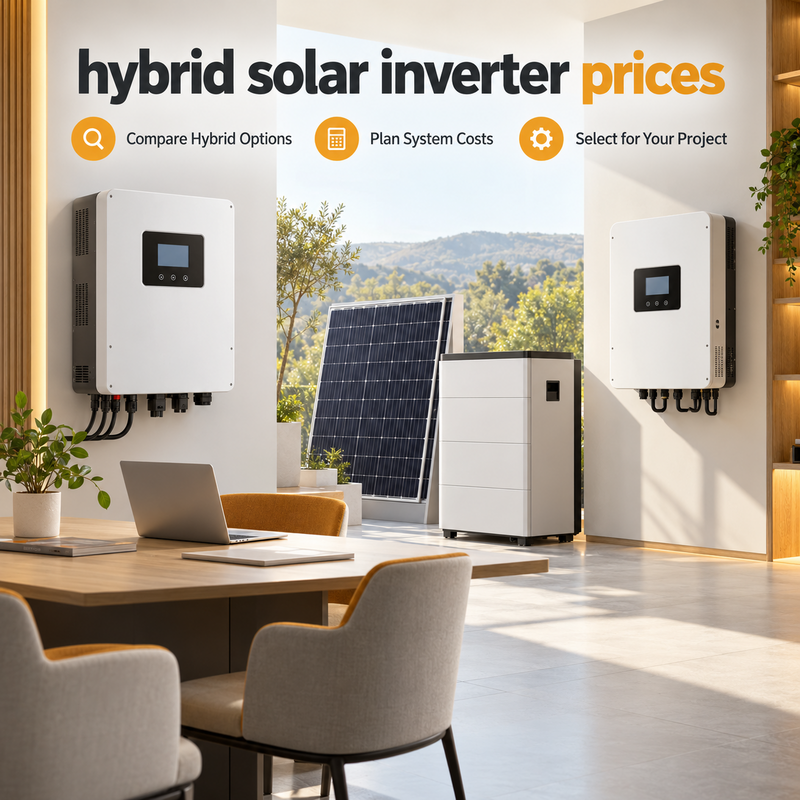
Understanding Hybrid Solar Inverter Prices

5,000+ units ready stock, 1–5 days fast global delivery

application/hybrid-solar-inverter-prices, application/hybrid-solar-inverter-prices, 
Inquiry
Inquiry

hybrid solar inverter prices

Understanding hybrid  solar inverter prices  is crucial for businesses looking to  invest in renewable  energy solutions. These inverters play a vital role in converting and managing  energy from both solar panels and the grid, making them an essential  component for  a range of applications,  including  residential, commercial, and industrial setups. As purchasing  managers and engineers  evaluate  their options, they often have concerns regarding  pricing, quality, and supplier reliability. This article will  help  you navigate these considerations, providing  insights  into hybrid solar  inverter prices, key  factors influencing costs,  and how to find trustworthy suppliers.

Key Factors to Consider

Key Factors to Consider

When evaluating  hybrid solar inverter prices,  several  key factors should  be taken into account:

Specifications: Understand the technical specifications that matter for your  application, including voltage range, maximum output wattage, and compatibility with solar panel systems.

Customization Options: If  your project  requires specific features or designs, customization  may affect the price. Discussing these needs with potential suppliers early in the negotiation process can lead to more accurate quotations. 

Quality Standards: Ensure that the inverters comply with relevant quality standards and certifications. Products meeting  international safety and performance standards may have a higher price but offer long-term reliability.

Warranty and Support: Inquire about warranty terms  and after-sales support. A longer warranty might  indicate higher confidence in product  durability, yet it  could also influence the upfront cost.

Market Conditions: Keep an eye on market trends  and fluctuations in raw material prices, as these  can directly affect  the cost of manufacturing hybrid solar inverters.

By carefully analyzing  these factors, purchasers can make informed decisions  that align with their budgets and project requirements.

Where to Find Reliable Suppliers for Hybrid Solar Inverters

Finding a reputable  supplier for hybrid solar inverters is essential  to ensure quality and reliability.  Here are several strategies  to locate trustworthy manufacturers:

Industry Trade  Shows: Participating in renewable energy trade shows allows buyers to meet suppliers, view  products firsthand, and discuss specifications in detail.

Online Marketplaces: Websites like Alibaba and Global Sources  can connect you  with numerous suppliers. However, it’s essential to  verify their certifications and reputation through  reviews and ratings.

Direct Manufacturer Outreach: Research manufacturers known for  their expertise in energy storage and hybrid systems, such as Shenzhen Yanshuosheng Technology Co., Ltd. Contacting them directly can provide insights into their production capabilities and available products. Additionally, exploring options like the Energy Storage Systems 3.6KW 5.5KW 24V 48V On/Off Grid Solar Inverter can further enhance your energy management solutions.

Networking: Engage  with industry professionals through forums, LinkedIn, or local business associations. Recommendations from peers can lead to finding reliable suppliers  who have a proven track record.

Quality Audits: Once  potential suppliers are identified, conducting  quality audits can help assess their manufacturing processes and quality control systems, ensuring they meet  your standards.

By employing these strategies,  buyers can better identify reliable suppliers, leading to successful procurement of hybrid solar  inverters.

Evaluating Quality Standards for Hybrid Solar Inverter Purchases

Quality  standards are a critical consideration when purchasing hybrid solar inverters.  Here are the primary aspects to evaluate:

Certifications: Look for certifications such as UN38.3  and CE, which indicate that the products  have undergone rigorous testing for safety and performance. These certifications can provide peace of mind regarding the  inverter’s reliability.

Material Quality: Assess the materials used in manufacturing the inverters. High-quality components contribute to  better performance and longevity.  For example,  inverters that utilize advanced thermal management systems tend to operate more efficiently  under varying environmental conditions.

Performance  Testing: Request information about performance testing protocols. Manufacturers should have documented procedures to ensure their products  meet  specified output  and efficiency ratings. This  transparency can help avoid issues post-installation.

Customer Feedback: Investigate customer reviews and feedback regarding the performance of specific inverter models. Real-world experiences can offer  insights into potential issues and  overall satisfaction.

Long-Term Reliability: Consider the  manufacturer's  track record concerning product  failures and warranty claims. A history of minimal issues can indicate a trustworthy supplier.

By focusing on these quality factors, buyers can enhance their confidence in the hybrid solar inverters they choose, ultimately leading to better operational performance.

Applications of Hybrid Solar Inverters in Various Industries

Hybrid solar inverters find applications across multiple industries, making  them versatile solutions for energy  management. Here are some key applications:

Residential Use: Homeowners increasingly invest in hybrid solar inverters to  optimize energy consumption and reduce electricity costs.  These systems  allow for the seamless integration of solar energy and grid  power, providing backup during outages.

Commercial Applications: Businesses benefit from  hybrid solar inverters by leveraging solar energy to reduce operational costs. These systems can manage energy loads  efficiently, ensuring that excess energy is  stored for later use or  fed  back into the grid.

Recreational Vehicles (RVs): Hybrid solar inverters are popular in RV applications, allowing users to harness solar energy during travel. This capability enhances energy independence and reduces reliance  on traditional fuel sources.

Marine Applications:  In marine environments, hybrid solar inverters support  energy needs on boats and yachts. They provide a reliable power  source for onboard systems while minimizing the need for fossil fuels.

Uninterruptible Power Supply (UPS): Hybrid solar inverters are integral to UPS  systems, ensuring that critical loads maintain power during grid failures. This application is particularly relevant for hospitals, data centers, and other facilities that  require constant power availability.

By understanding these diverse applications, purchasers  can  better identify how hybrid solar inverters will meet their specific operational needs and contribute to sustainability  goals.

Understanding Hybrid Solar Inverter Prices for Bulk Orders

When purchasing hybrid solar inverters in bulk, prices can vary significantly based on several factors.  Generally, the price per unit decreases with larger order quantities, which can lead to substantial cost savings for  businesses. Factors influencing pricing include the  inverter’s specifications,  such as power output,  efficiency rating,  and included  features like integrated battery management systems (BMS). 

For instance, a hybrid  solar inverter  with a higher output capacity or  advanced functionalities may command a higher price. Additionally, the brand  reputation and manufacturing  quality also impact costs. Companies that prioritize quality  assurance and have established certifications, such as UN38.3 and CE, often  charge more due  to the  reliable performance and safety standards their products meet. Shenzhen Yanshuosheng Technology Co., Ltd., for example, specializes in high-quality LiFePO4 energy storage  systems, which can influence the  overall  pricing strategy for their hybrid solar inverters. If you're considering energy storage solutions, you might also explore the High Performance 50Ah LiFePO4 Lithium Ion Battery Pack Deep Cycle 12V High Efficiency Lithium Iron to complement your system.

Get a Free Quote

Our representative will contact you soon.
0/1000