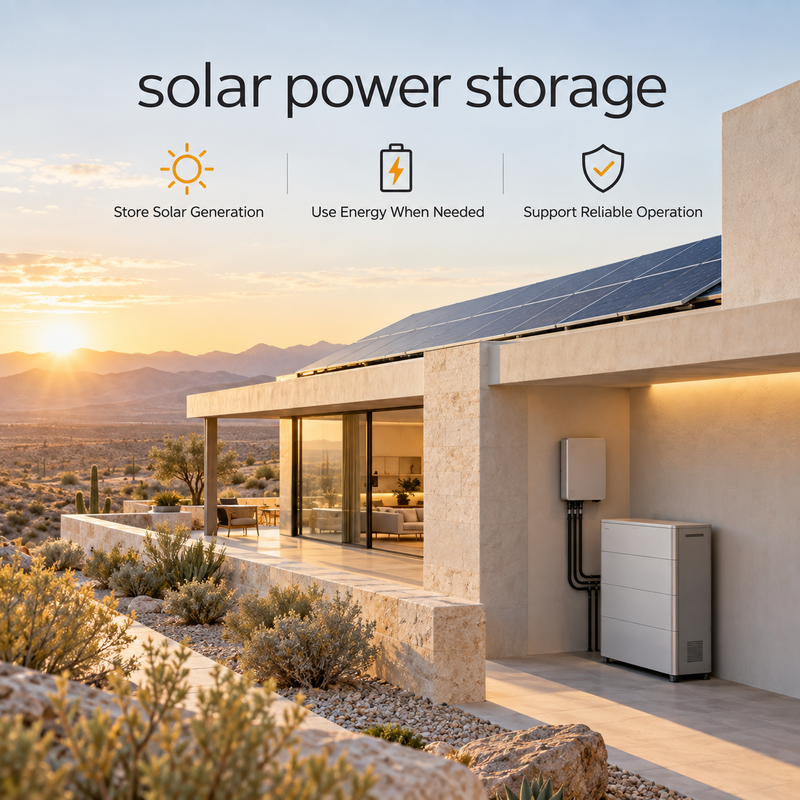
Choosing the Right Solar Power Storage Solution

5,000+ units ready stock, 1–5 days fast global delivery

application/solar-power-storage, application/solar-power-storage, 
Inquiry
Inquiry

solar power storage

Understanding  solar  power storage solutions is essential  for businesses looking to optimize energy efficiency and reduce costs.  These systems,  particularly LiFePO4 energy storage systems, offer reliable and sustainable ways to store energy generated from renewable sources. However,  with various options  available, B2B  buyers often face challenges in selecting  the right  system for their  specific needs. This article will guide you  through  the critical considerations  for choosing  solar  power storage solutions, evaluating partners, best practices for implementation, understanding your investment, and how solar power  storage fits into  your  projects.

What to Look for in Solar Power Storage Partners

What to Look for in Solar Power Storage Partners

Choosing the right partner for solar power storage is just as crucial as selecting the product itself. Start by verifying their manufacturing capabilities and whether they have relevant certifications, such as UN38.3 and CE, which ensure compliance with international  safety standards.

Next, consider the partner's experience in the industry. A supplier  with a strong  track record in providing energy storage solutions across various applications, such as residential, RV, UPS, and marine, will likely  have  the expertise to  address your  unique requirements. Furthermore,  inquire about their customization capabilities. A partner who can  tailor solutions to fit  your specific application will provide greater  value and performance.

Quality control processes are also vital.  Ensure that your partner has rigorous  testing protocols in place to verify  battery  performance  and longevity. This can include temperature and cycle  testing to confirm that the products  will  perform as expected under real-world conditions.  Additionally, consider asking about products like the Deep Cycle LiFePO4 Lithium Ion Solar Energy Battery Storage Systems as part of your inquiry.


Best Practices and Tips

When implementing solar power storage systems,  following best practices can enhance efficiency  and longevity. First, ensure proper installation. Engage professionals who are familiar with  LiFePO4 systems to minimize risks associated with incorrect setup. Moreover, conduct  regular maintenance checks to monitor battery health and performance, which can  prolong the  lifespan of your investment.

Consider using a Battery Management System (BMS) if not integrated into your storage solution.  A BMS ensures that the  battery  operates within safe parameters, preventing overcharging and deep discharging, which can  degrade battery  performance.

Educate your  team  about the operational  aspects of the solar  power  storage system. Understanding how to  effectively  manage energy consumption and storage can lead to more  significant savings  and better utilization of the system.

Understanding Your Investmen

Investing in solar power storage is a significant financial  commitment, and understanding the return on investment  (ROI)  is critical. Begin by calculating  the expected savings  on energy  costs over  time. Consider the  initial purchase price, installation costs, and any ongoing maintenance expenses against  the savings from reduced energy bills and  potential subsidies or tax incentives.

Additionally, factor in the lifespan of the LiFePO4 batteries. With a longer lifespan and lower degradation rates compared to other battery types, these systems can provide a more favorable ROI. Buyers should also evaluate  the potential for energy independence and resilience against power  outages, adding further value to  the investment.

Lastly,  keep track of  any technological advancements in solar power  storage.  New innovations could enhance efficiency or  reduce  costs, making it  worthwhile to stay informed and consider upgrades in the future.

Where It Fits in Your Projects

Solar  power storage systems can be integrated into various projects, enhancing energy efficiency across multiple sectors. In commercial settings, these systems are ideal for  managing peak loads, effectively reducing energy costs during  high-demand periods. They  are also beneficial in renewable  energy projects, where they can  store excess energy generated from solar panels for later usage.

In  residential applications, solar power storage can  significantly enhance energy independence. Homeowners can utilize stored  energy during grid outages or at  night, reducing reliance  on traditional energy sources.


For industries like RV and marine, solar power  storage provides a reliable energy source for powering appliances and systems, enabling longer trips without worrying about fuel availability. Understanding the diverse applications of solar power storage can help businesses identify how best to leverage these solutions  in their projects.

By carefully considering these aspects, B2B buyers can  make informed  decisions that align  with their energy  goals and operational needs.  Engaging with a  knowledgeable supplier like Shenzhen Yanshuosheng Technology Co., Ltd. can further ensure the right products and expertise are at your disposal, maximizing the benefits of solar power storage.

How to Choose the Right Solar Power Storage Solution for Your Needs

When selecting a solar power storage solution, begin by assessing your specific energy requirements. Consider factors such  as the total energy consumption of your facility, peak usage times, and the integration of solar panels.  LiFePO4 batteries, known for their long cycle life and safety,  are a popular choice in this regard. Ensure that the selected system  can handle your peak load and has sufficient storage capacity  to meet your needs  during periods of low solar  output.  Additionally, you may want to explore options like the Energy Storage Systems for various capacities to enhance your setup.

Next, evaluate the technical specifications of the solar power storage system. Key specifications include the battery capacity  (measured in kWh), discharge depth, cycle life, and  efficiency  rate. A higher  capacity allows for more energy storage,  while  a reputable cycle life ensures longevity, reducing replacement frequency. Additionally, efficiency  rates will influence the amount of energy lost during storage and retrieval.

Finally, assess your future  needs. If  you anticipate scaling your solar  system or increasing  energy demands,  opt for a modular  solution that can be expanded easily. This foresight can prevent costly upgrades down the line.

Get a Free Quote

Our representative will contact you soon.
0/1000