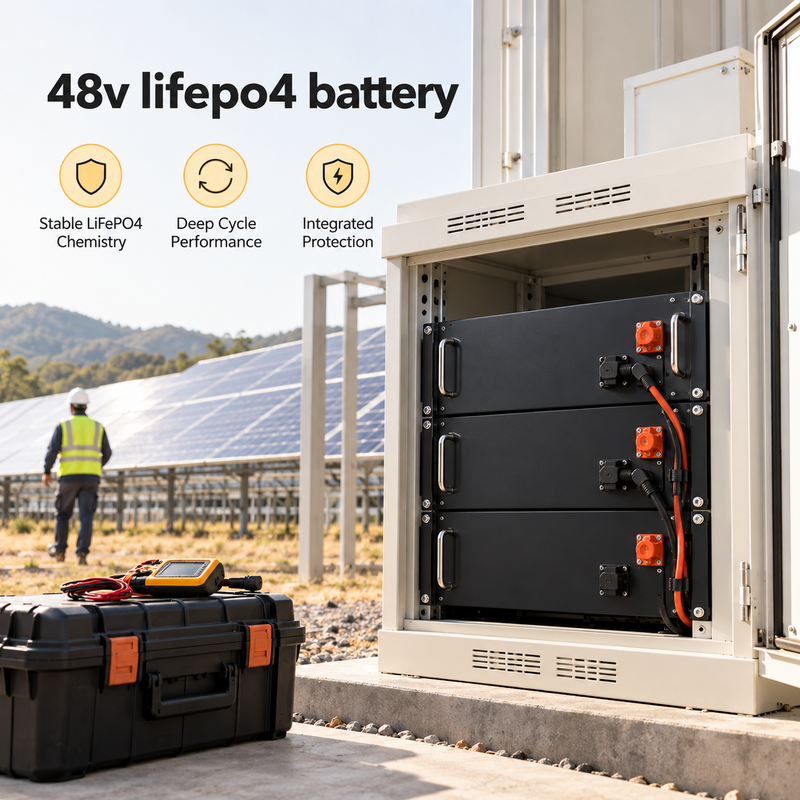
Choosing the Best 48V LiFePO4 Battery for Your Needs

5,000+ units ready stock, 1–5 days fast global delivery

application/48v-lifepo4-battery, application/48v-lifepo4-battery, 
Inquiry
Inquiry

48v lifepo4 battery

Choosing the  right 48V LiFePO4 battery is  crucial for various applications in energy  storage, especially in industries  focused on solar energy, RVs, UPS systems, and marine uses. This article will  explore critical  aspects  of  48V  LiFePO4  batteries, addressing  B2B buyer concerns  such as  product specifications, sourcing reliable suppliers,  installation considerations, common issues, and industry applications. By  understanding these  components,  purchasing managers and engineers can make informed decisions that meet  their operational needs.

 
Where to Source High-Quality 48V LiFePO4 Battery Suppliers

Where to Source High-Quality 48V LiFePO4 Battery Suppliers

Sourcing high-quality 48V  LiFePO4 batteries starts with  identifying reputable manufacturers. Look for suppliers with  established certifications, such  as UN38.3 and CE, which indicate compliance with international safety and quality standards.  Additionally, check for ISO certifications, which can further assure you of the manufacturer’s commitment to quality management.

It's also beneficial to evaluate  the manufacturer's production capabilities and experience in the industry. A supplier  with extensive experience in LiFePO4 technology is more likely to understand  the  nuances of battery performance and application requirements. Requesting product samples can help assess quality  firsthand before placing larger orders.

Another critical consideration is  the supplier’s ability to customize products based on your specifications. Whether you  need  different sizes, terminal  configurations, or packaging options, a flexible manufacturer can  better meet  your operational needs. Lastly,  consider the supplier’s geographical reach  and logistics capabilities,  especially if you require  timely delivery across different regions.

Installation Guidance for 48V LiFePO4 Battery Systems

Proper installation of 48V LiFePO4 battery  systems  is essential for optimal performance and safety. First, ensure that the  installation site is well-ventilated and protected  from extreme temperatures, as LiFePO4 batteries perform best in moderate conditions. </p>

When  connecting batteries  in a series or parallel configuration, always follow the manufacturer’s guidelines to avoid imbalances that can lead to reduced performance or  damage.  Use appropriate gauge wiring to handle the  expected current load, which will minimize voltage drop and heat generation.


Incorporating a well-designed  BMS during installation is critical. The BMS monitors the battery's voltage and  temperature, ensuring  that each cell operates  within safe limits. This system also manages  charging and discharging  cycles, extending the battery's lifecycle. Before finalizing the installation, conduct a thorough inspection to confirm all connections  are  secure and that the setup meets all  electrical codes and safety standards.


Common Problems with 48V LiFePO4 Batteries and Their Solutions

While 48V LiFePO4 batteries are known for their durability and efficiency, users may  encounter some common issues. One  prevalent problem is inadequate charging, which can stem from using an incompatible charger.  Ensure that the charger is specifically designed for LiFePO4  batteries and matches the required  voltage  and amperage specifications.

Another issue is temperature sensitivity.  If the battery overheats, it may trigger the BMS to disconnect it from the load. Such disconnections  can result from environmental factors  or poor ventilation. To mitigate this risk,  monitor operating temperatures and ensure the installation  area is  appropriately cooled.


Finally, users may experience diminished capacity over time. This can result from excessive depth of discharge or poor maintenance practices. Regularly  monitoring the  state of charge (SoC)  can help prevent over-discharging, while periodic capacity testing can identify any degradation in performance. Implementing proper  charging practices  and routine maintenance  will  enhance the lifespan and reliability of your LiFePO4 batteries.

Exploring Applications of 48V LiFePO4 Batteries in Various Industries

The versatility of 48V LiFePO4 batteries makes them  suitable  for a wide range of applications  across different industries. In the renewable energy sector, these batteries are widely used  for solar energy storage systems, providing a reliable power source for homes and businesses. Their high energy  density and efficiency make them ideal for storing excess solar energy generated during the day for use at night or during cloudy days, often integrated with systems like the High Performance 50Ah LiFePO4 Lithium Ion Battery Pack.

In the recreational  vehicle (RV) market, 48V  LiFePO4 batteries are favored for their lightweight and compact design, which significantly reduces overall vehicle weight while providing ample power for appliances and systems. This advantage is crucial for enhancing the range and usability of electric RVs.

In marine applications, these batteries offer robust performance and longevity, making  them suitable for powering electric motors and onboard systems without the need for  frequent replacements. Their resistance to corrosion and ability to withstand harsh marine environments add to their  appeal.

Additionally,  in uninterruptible power supply (UPS)  systems, 48V LiFePO4 batteries provide reliable backup power, ensuring continuous operation of essential  equipment during outages. Their rapid charging capabilities and longer lifespan compared to traditional lead-acid batteries  make them a cost-effective solution  for critical power  applications.

In  summary, understanding the specifications, sourcing reliable suppliers, ensuring proper installation, addressing common issues, and exploring various applications can  significantly aid B2B buyers in making informed decisions  regarding 48V LiFePO4 batteries.  By focusing on these key aspects, purchasing managers and engineers can optimize their energy storage solutions to meet their operational demands effectively.

Choosing the Right 48V LiFePO4 Battery for Your Applications

Selecting the appropriate 48V LiFePO4  battery involves  understanding  your specific needs, including application type, required capacity, and environmental conditions. A key specification to  consider is  the battery's capacity,  typically measured in amp-hours (Ah). This  determines how long  the battery can sustain a certain load. For instance, a battery with a capacity of 200Ah can theoretically provide 200 amps for one  hour or 100 amps for two hours.


Another  important  factor  is the depth of discharge (DoD). LiFePO4  batteries generally allow for a higher DoD (up to 90%) compared to other  lithium-ion batteries, which means you can  utilize more of the battery’s capacity without damaging it. This feature is particularly beneficial for applications requiring extended usage, such as renewable energy storage systems. In fact, systems utilizing Energy Storage Systems can greatly enhance the efficiency of energy usage.

Additionally, evaluate the battery's cycle life, which indicates how many charge/discharge cycles it can complete before its capacity significantly diminishes.  A higher cycle life translates  into longer-term savings and reduced maintenance costs. Lastly, ensure  that the battery features an integrated Battery Management System (BMS), which safeguards against overcharging, deep discharging, and thermal runaway, enhancing safety  and longevity.

Get a Free Quote

Our representative will contact you soon.
0/1000