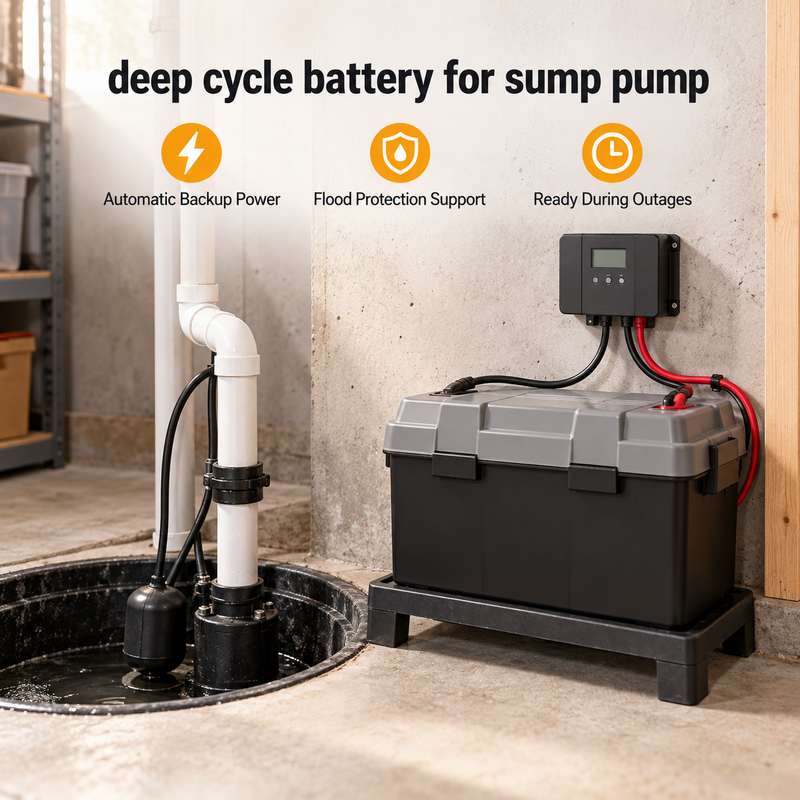
Deep Cycle Battery for Sump Pump: A Complete Guide

5,000+ units ready stock, 1–5 days fast global delivery

application/deep-cycle-battery-for-sump-pump, application/deep-cycle-battery-for-sump-pump, 
Inquiry
Inquiry

deep cycle battery for sump pump

Deep  cycle batteries are crucial  for ensuring the  reliability of sump pumps, especially  in applications where water damage prevention is paramount. When  selecting  a  deep  cycle  battery for a sump pump, buyers  often have  concerns about  performance, longevity,  and compatibility with their existing  systems. This article will guide you through  choosing the  right  deep cycle battery for your sump pump, addressing  common  issues  and providing insights into effective setups, quality indicators, and application considerations.

Common Problems with Sump Pump Batteries and Effective Solutions

Common Problems with Sump Pump Batteries and Effective Solutions

Sump pump  batteries can face several common issues  that affect  their performance. One frequent problem  is sulfation, which  occurs in lead-acid batteries when they are left in a discharged state  for too long. To mitigate this, regularly check  the battery's state of charge and maintain a consistent charging schedule.

Another  issue is battery  size and weight. Some users may select batteries that are too  heavy or large for their sump pump compartments. Always confirm that the physical dimensions of the battery fit within the designated space, allowing for proper ventilation and  accessibility.

Temperature fluctuations can  also impact battery  performance. For instance, lead-acid batteries can  suffer from  reduced capacity in cold conditions. In contrast, LiFePO4 batteries maintain performance across  a wider temperature range,  making  them a preferred choice for varied climates. If you operate in extreme temperatures,  consider insulating your battery or choosing a thermal management solution.

Deep Cycle Battery Setup for Sump Pumps

Proper setup of your deep cycle battery is critical for  optimal performance. First, ensure that the battery connections are  secure and  free from corrosion. Use appropriate gauge wiring to reduce resistance  and  improve efficiency;  the wire size should  match the current requirements  of the  sump pump.

If you are using a lead-acid battery, install a battery maintainer or smart charger to keep it  charged without overcharging, as this can lead to battery damage.  For  LiFePO4 batteries, select  a compatible charger that  matches the  battery's specifications to maximize longevity and performance. The Energy Storage Systems 3.6KW 5.5KW 24V 48V On/Off Grid Solar Inverter Pure Sine Wave Inverter MPPT Hybrid Inverters are also recommended for use with these batteries.

Additionally, consider implementing a battery management system (BMS), especially  for lithium batteries. A BMS helps monitor the  state of charge, temperature, and overall health of  the battery, providing protection against overcharging, deep discharging,  and  overheating.

What to Look For in Quality

When evaluating the quality of  a deep cycle battery for sump pumps, several indicators can help guide your decision. Start  with battery construction;  look for robust  materials that ensure durability and resistance to environmental factors. A well-constructed battery will  have reinforced terminals and a sturdy casing.

Next,  check for certifications. Batteries with UN38.3 and CE certifications have met international safety and performance standards, providing assurance of their reliability. Additionally, inquire about the manufacturer's quality  control processes.  A  reputable manufacturer, such as Shenzhen Yanshuosheng Technology Co.,  Ltd., will implement rigorous testing protocols throughout  production to ensure  consistent quality.

Lastly, consider the warranty offered  with the battery. A  longer warranty period  often indicates confidence in the product's performance and longevity. Look for warranties that cover  performance as well as defects, which can provide peace of  mind  for your investment.

Applications of Deep Cycle Batteries in Sump Pump Systems

Deep cycle batteries are  integral to the operation of sump pump systems across various applications. In residential settings, they provide backup power during outages, ensuring that sump pumps continue to operate during critical times. This is particularly important in flood-prone  areas where water accumulation can lead to significant damage.

In commercial  applications, deep cycle batteries  support larger sump pump systems  in basements or  industrial facilities, where water management is essential for equipment protection  and facility integrity. The  reliability and long life of  LiFePO4 batteries make them an attractive option for these environments, where downtime can be costly.

Additionally, deep cycle batteries can be  utilized in conjunction with renewable energy sources, such as solar panels. This setup creates a sustainable solution for powering sump  pumps, reducing reliance on  grid electricity and providing an  eco-friendly alternative for water management  systems. For optimal performance, consider integrating the All-in-One Energy Storage System 5.5KW / 7.5KW Hybrid Cabinet for Large Homes into your setup.

By understanding the specifics  of  deep cycle batteries and their applications  in sump pump systems, buyers can make informed decisions  that  ensure reliability and efficiency in their water management strategies.

How to Choose the Right Deep Cycle Battery for Your Sump Pump

When selecting a  deep cycle battery  for your sump pump, consider several critical factors. First,  determine  the power  requirements of  your sump pump. Check the pump's specifications  for its voltage and current draw to ensure compatibility with  your chosen battery. Most  sump  pumps operate on either 12V or  24V systems, so selecting a battery that matches  this voltage is essential.

Next, evaluate the battery's capacity, measured in amp-hours (Ah). A higher Ah rating means the battery can run the sump pump for a  longer period before needing a recharge. For instance, if  your sump pump draws 5 amps and you require it to run for 12 hours during a heavy storm, you would need a battery with at least 60Ah. However, to account for efficiency losses, consider a battery with a slightly higher capacity. If you are looking for high-performance options, consider the High Performance 50Ah LiFePO4 Lithium Ion Battery Pack Deep Cycle 12V High Efficiency Lithium Iron.

Lastly, consider the battery type. Lithium  Iron Phosphate (LiFePO4) deep cycle batteries,  like those produced by Shenzhen Yanshuosheng Technology Co., Ltd., offer advantages such as longer lifespan, faster charging, and lighter weight compared to traditional lead-acid batteries. Ensure the battery you select has the necessary certifications, such as  UN38.3 and CE, to guarantee safety  and performance  standards.

Get a Free Quote

Our representative will contact you soon.
0/1000