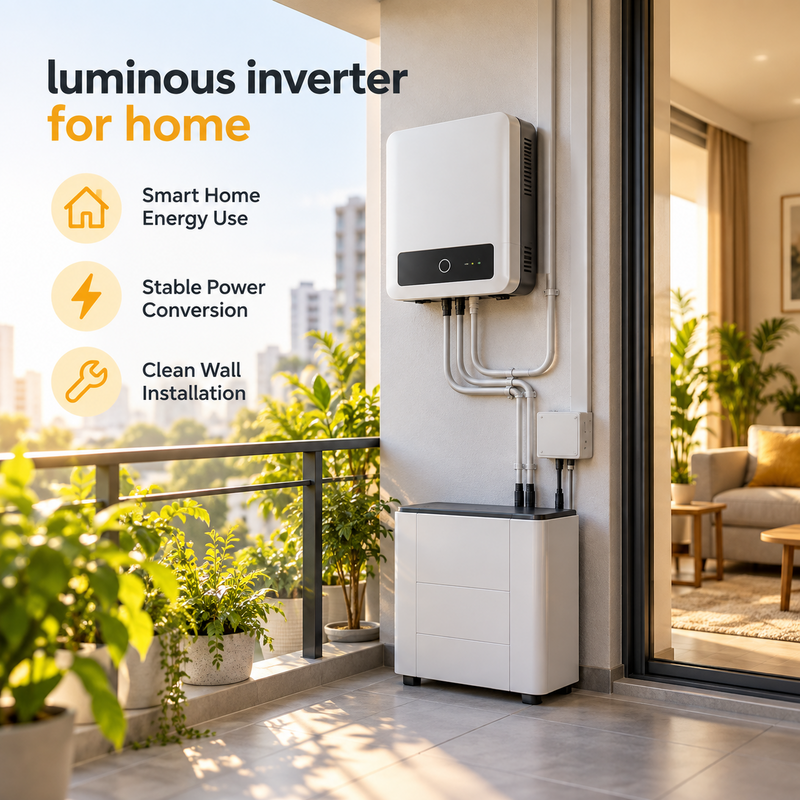
Luminous Inverter for Home: Key Considerations

5,000+ units ready stock, 1–5 days fast global delivery

application/luminous-inverter-for-home, application/luminous-inverter-for-home, 
Inquiry
Inquiry

luminous inverter for home

Luminous inverters for home applications are essential devices that convert direct current (DC) from  energy storage systems into alternating current  (AC) for  use in residential settings.  When considering a purchase, buyers  are  often  concerned about  reliability, efficiency, compatibility with existing systems, and the  overall cost. This article will delve  into  how  to select a trustworthy  supplier,  factors  affecting  quality and cost, installation guidance,  purchasing considerations  for wholesale orders, and the advantages  of LiFePO4 technology  in luminous inverters.

Quality and Cost Considerations

Quality and Cost Considerations

When it  comes to luminous  inverters, both quality and cost play crucial roles in the purchasing decision. High-quality inverters  often feature advanced technology, such as independent Battery  Management Systems (BMS), which help optimize performance and extend  battery life. In  contrast, cheaper alternatives may compromise on essential features, leading to increased  operational  costs over time due to inefficiencies or  shorter lifespans.

A critical aspect to consider is  the material used in the inverter's construction. LiFePO4 batteries,  for  instance, are known for their longer cycle life and enhanced safety compared to other lithium-ion batteries.  While they may have a higher initial cost,  their longevity and stability can lead to lower total cost  of ownership.

Additionally, buyers should be aware of  the total cost of acquisition, including shipping, installation, and maintenance. Ensuring  that you have a comprehensive understanding of these factors  can help  you make a  more informed decision that balances quality with cost-effectiveness.

Installation Guidance for Luminous Inverters in Residential Settings

Installing a luminous inverter in a  residential setting  requires  careful  planning and adherence to safety  standards. First, it is essential to ensure that the  inverter's specifications align with the home’s electrical  system. This includes  verifying the inverter’s capacity, which should match or exceed  the home's energy consumption needs.

Before installation, it's advisable to consult  with  a qualified electrician who  can assist in determining the optimal placement of the inverter for efficient airflow and  accessibility. Proper installation not  only enhances performance but also ensures safety  by reducing the risk of overheating or electrical  faults.

Once installed, regular maintenance checks are recommended to ensure that  the inverter  operates at peak efficiency. This  includes inspecting connections, cleaning any dust or debris, and monitoring performance metrics. Following the manufacturer’s installation and maintenance guidelines will help prolong the lifespan of the inverter  and ensure reliable performance.

What to Look for in Wholesale Luminous Inverter Purchases

When considering wholesale purchases of luminous inverters, several factors should be on your checklist. Start by assessing the minimum order quantity (MOQ)  required by the supplier. A reputable manufacturer will  provide flexible MOQs  that  cater to businesses of various sizes.

Next, request detailed  product specifications, including performance ratings, dimensions, and compatibility with different battery systems. This information is crucial for ensuring that  the inverters  you  purchase will meet your operational  needs without the risk of underperformance.

Additionally, inquire about customization options  that may be  available for your  bulk order. Customization  can include adjustments to performance specifications, branding, or packaging,  which can enhance the product’s appeal and  suitability for your market.


Finally, ensure  that the supplier provides transparent pricing structures and clear terms regarding lead  times,  shipping options, and payment  conditions. This clarity will facilitate smoother transactions and help you avoid unexpected costs down the line.

Understanding the Advantages of LiFePO4 in Luminous Inverters

LiFePO4 (Lithium Iron Phosphate) batteries offer significant advantages for use in luminous inverters, making them a preferred choice in many applications. One of  the primary benefits is their enhanced safety profile; LiFePO4 batteries are  less prone to thermal runaway compared  to  other lithium-ion chemistries, making them  safer for residential use.

Another advantage is their longevity.  LiFePO4 batteries generally have a longer cycle life, often exceeding 2000  cycles, which translates to reduced replacement costs over time. This durability makes them a cost-effective option in the long run, despite a higher initial investment.

Furthermore, LiFePO4  batteries  exhibit excellent thermal stability, allowing them  to perform  optimally in  a wider range  of temperatures. This characteristic is crucial for  residential applications where environmental conditions  can vary  significantly.

In summary, investing in luminous inverters that utilize LiFePO4  technology can provide buyers with a reliable, efficient, and  safe  energy solution for their homes, ultimately leading to long-term savings and peace of mind.


How to Choose a Reliable Supplier for Luminous Inverters

Selecting a  dependable supplier for luminous inverters involves evaluating several key aspects. First, assess the manufacturer’s  experience and expertise in the  field. A company like Shenzhen Yanshuosheng Technology Co., Ltd., which specializes in LiFePO4 energy storage systems, can provide insight into industry standards and best practices.

Next, review certifications such as UN38.3 and CE, which  indicate compliance with  safety and performance regulations. These certifications are crucial in ensuring that the products meet industry standards  for quality and safety. Additionally,  consider the  supplier's production capabilities, including their manufacturing processes and equipment,  which can impact  the  inverter's efficiency and longevity.

It's also beneficial to ask  for references or case studies from previous clients. This  can provide you with information about the supplier's reliability, customer service, and the performance of their products  in real-world applications. Finally, ensure that  the supplier can offer customization  options to meet your specific requirements, as this flexibility can significantly  enhance  your operational  efficiency.

Get a Free Quote

Our representative will contact you soon.
0/1000