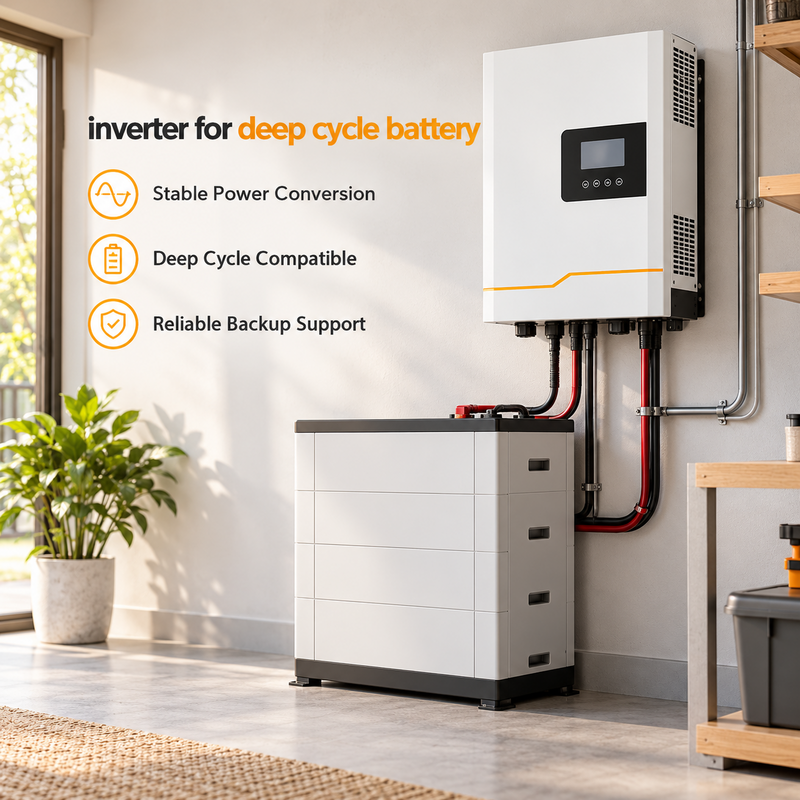
Inverters for Deep Cycle Batteries: Key Insights

5,000+ units ready stock, 1–5 days fast global delivery

application/inverter-for-deep-cycle-battery, application/inverter-for-deep-cycle-battery, 
Inquiry
Inquiry

inverter for deep cycle battery

Inverters for deep cycle batteries are essential components for powering various applications,  from solar energy  systems  to recreational vehicles (RVs) and marine equipment. B2B  buyers,  such as purchasing  managers and engineers,  are  often concerned with product specifications, compatibility, and reliability  when selecting an inverter. This article will delve  into  the critical aspects of inverters  for deep cycle  batteries,  covering  technical specifications, common issues, installation guidance, comparative  options,  and quality assurance  measures  to aid buyers  in making informed decisions.

Common Problems with Inverters for Deep Cycle Batteries and Solutions

Common Problems with Inverters for Deep Cycle Batteries and Solutions

Inverters for deep cycle batteries can encounter various issues that may affect their performance. One common problem is overheating, which can be caused by excessive load or poor ventilation. To mitigate this, ensure  the inverter is installed in a well-ventilated area and avoid exceeding its rated capacity.

Another  frequent issue is  battery compatibility. Not  all inverters work effectively  with every battery type. It's crucial to  confirm that the inverter is compatible with the specific  deep cycle battery being used, particularly regarding its  voltage  and chemistry. For instance, lithium iron  phosphate (LiFePO4) batteries,  which are increasingly favored for  their efficiency and longevity,  require inverters designed to handle their specific charging and discharging characteristics. You can explore options like the Deep Cycle LiFePO4 Lithium Ion Solar Energy Battery Storage Systems to ensure proper compatibility.


Users may also experience issues  with inverter performance during low battery states. Many inverters will shut down or enter a low power mode  if battery levels drop too low to protect the battery from  damage. To  prevent this, implementing a battery management system  (BMS) can help monitor battery health and  maintain optimal performance.

Installation Guidance for Inverters in Deep Cycle Battery Systems

Proper installation is critical  for ensuring the efficient operation of inverters for  deep cycle battery  systems. First,  it's essential  to choose a suitable location for the inverter that allows for adequate airflow and protects it from moisture and extreme temperatures. The installation area should also  be easily accessible  for maintenance.

Wiring connections play a  vital role in the installation process.  Use appropriately sized cables to minimize  voltage drop and ensure safe operation. It’s  advisable to follow the manufacturer's guidelines for wire  gauge based  on the distance between  the inverter and the battery. Additionally, ensure that all connections  are secure to avoid arcing or disconnections during operation.

Finally, consider integrating a  fuse or  circuit breaker in the system to  protect the inverter and batteries from electrical faults. This safety measure can help prevent  damage and ensure the longevity of the  equipment.

Comparing Inverter Options for Deep Cycle Battery Use Cases

When evaluating  inverter options for deep cycle batteries, it's essential to compare various models based on specific use cases. For solar applications, look for inverters  with built-in maximum power point tracking  (MPPT) technology,  which optimizes the energy harvested  from solar  panels,  enhancing system efficiency. You might consider looking into Energy Storage Systems that feature MPPT for enhanced performance.

For RV and marine applications,  consider inverters designed for mobility, which often include features  like compact design and lightweight materials. Additionally,  these inverters  frequently come with built-in protections against marine conditions, such as humidity and vibrations.

Another consideration is the inverter's ability to handle multiple battery types.  If your operations may require switching  between different battery chemistries or capacities, a more versatile inverter that accommodates various configurations can offer long-term flexibility.

Buyers  should  also assess the warranty and  support options provided by the manufacturer. A robust warranty and responsive technical support  can be invaluable, particularly for businesses relying  on consistent power supply  in  critical applications.

Ensuring Quality in Deep Cycle Battery Inverters

Quality assurance is paramount when selecting inverters for deep cycle batteries.  Buyers should  ensure that the inverters  they consider come  with relevant certifications, such as CE  and UN38.3, which indicate  compliance with safety and performance standards. These certifications can  provide assurance of the product's reliability and suitability for  demanding applications.

Moreover, understanding the manufacturer's quality control processes can offer insights into the expected performance and lifespan of  the inverter. A reputable manufacturer should have rigorous testing protocols in place, including stress testing under various load  conditions and environmental simulations.

Buyers should also consider the availability of spare  parts and technical support, as these factors can influence the long-term viability of the inverter.  Establishing a relationship  with  a manufacturer like Shenzhen Yanshuosheng Technology Co., Ltd., known for its commitment to quality in LiFePO4 energy storage systems, can provide peace of mind regarding product longevity and  performance.

Making informed decisions in  selecting inverters for deep cycle batteries involves understanding technical specifications, recognizing  common pitfalls,  ensuring proper  installation, comparing available options,  and prioritizing quality assurance. By paying careful attention to these aspects, B2B buyers can enhance their operational efficiency and reliability in energy-dependent applications.

Understanding Technical Specifications of Inverters for Deep Cycle Batteries

When selecting an inverter  for deep cycle batteries, several technical specifications are paramount. Key specifications include  the inverter's power rating, which is measured in  watts  and determines how much power can be provided to connected devices. It's essential to choose an inverter that matches or exceeds the total wattage of all devices it will power to avoid overloads. For instance, if you're considering a high-performance system, you might want to look into a High Performance 50Ah LiFePO4 Lithium Ion Battery Pack to ensure compatibility.

Another  crucial specification is  the waveform output. Inverters typically produce either a pure  sine wave or  a modified sine wave. Pure sine wave inverters are preferred for sensitive electronics, as they provide a stable and clean power supply,  while modified sine wave inverters are often sufficient for simpler devices but can cause issues with more sensitive equipment.


The inverter's efficiency rating is also significant. This percentage indicates  how much of the input power is converted to output  power. Higher efficiency means less energy  is wasted  as heat, leading to longer battery life and  better performance.

Additionally, buyers should consider the inverter's surge rating, which reflects its ability to handle short bursts  of high energy demand,  such as when starting motors.  This is particularly important in applications like RVs and marine  environments, where devices may require more power  initially.

Get a Free Quote

Our representative will contact you soon.
0/1000